I was paying Stripe to process 3 payments a month. Then I checked the alternatives.
Stripe is the default answer for online payments. But if you only need one payment method, you're paying for features you'll never use. Here's what I found when I actually compared providers.
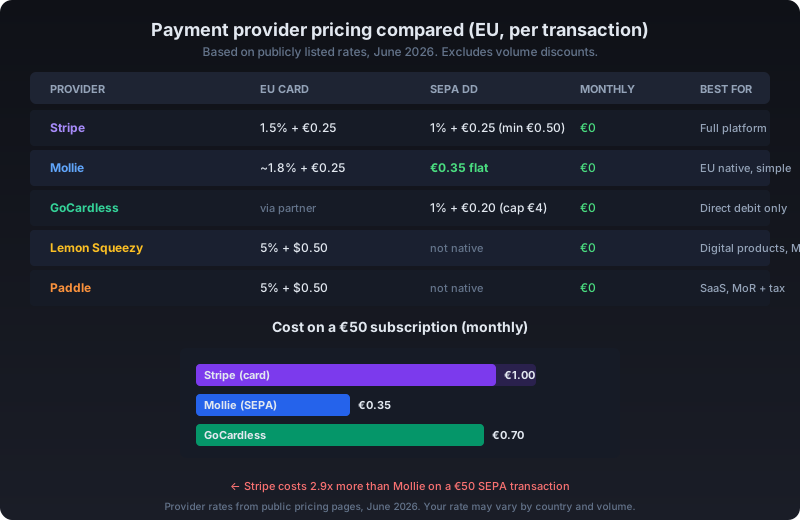
I was paying Stripe to process 3 payments a month.
Three. A €50 subscription here, a €20 one-off there. Maybe €120 in total volume. Stripe charged me €0.75 per card transaction (1.5% + €0.25) plus the €0.35 SEPA fee. Call it €3/month in fees.
I wasn’t using Billing. Wasn’t using Connect. Wasn’t using Radar, Sigma, or Tax. I was using maybe 5% of the platform.
So I spent an hour checking what else is out there. The results were annoying.
What Stripe actually costs in Europe
Stripe’s EU pricing is straightforward: 1.5% + €0.25 per card transaction, 1% + €0.25 per SEPA Direct Debit (minimum €0.50). No monthly fees, no setup fees.
For a pure card business at low volume, that’s €0.28 on a €20 sale. Not bad.
The problem is you’re buying into an ecosystem. Stripe wants you on Billing for subscriptions, Radar for fraud, Tax for VAT compliance, Connect if you ever do marketplace stuff. Each is a separate product with separate pricing. The platform makes sense at scale. At 3 transactions a month, it’s a sledgehammer.
The alternatives I actually found
I went through the providers that accept EU-based businesses and don’t require you to be a US company.
Mollie: the EU-native option
Mollie is Dutch, processes EUR natively, and their pricing is dead simple:
- iDEAL (Netherlands): €0.29 flat
- Bancontact (Belgium): €0.35 flat
- SEPA Direct Debit: €0.35 flat
- Cards (EU): around 1.8% + €0.25 depending on method
- No monthly fees
That’s it. No “add Radar for €0.02/transaction.” No “add Tax for 0.5%.” The rate is the rate. For SEPA Direct Debit, Mollie at €0.35 beats Stripe’s 1% + €0.25 (min €0.50) on any transaction under €50.
On my €50 subscription: Stripe takes €0.75, Mollie takes €0.35. That’s a 53% reduction on your biggest cost.
GoCardless: if you only do direct debit
GoCardless does one thing: bank payments. SEPA Direct Debit, BACS, ACH. Their pricing:
- SEPA Direct Debit: 1% + €0.20, capped at €4
- No monthly fees on Standard plan
On a €50 subscription: €0.70. On a €200 B2B invoice: €2.20 (vs Stripe’s €2.25). The cap matters at higher amounts.
Where GoCardless wins is the product: built for recurring bank payments, handles mandate management, retries failed payments automatically, and integrates with accounting software. If your business is subscriptions or invoicing and you don’t need cards, this is the tool.
Lemon Squeezy: the merchant-of-record option
Lemon Squeezy charges 5% + $0.50 per transaction. That sounds insane compared to Stripe’s 1.5%.
But they’re the merchant of record. They handle VAT/sales tax calculation, collection, and remittance globally. They handle fraud. They handle chargebacks. You get a payout and never think about tax compliance.
On a €20 digital product sale: Lemon Squeezy takes €1.50 (at current rates), Stripe takes €0.58. But with Stripe, you need to handle VAT yourself (or add Stripe Tax for 0.5%, bringing it to €0.68). And you still need to file returns in every country where you have customers.
If you sell digital products to EU customers and don’t want to become a tax compliance expert, that extra €0.82 per transaction might be the cheapest accountant you’ll ever hire.
Paddle: same model, more enterprise
Paddle is the same merchant-of-record model at 5% + $0.50. They position more toward SaaS companies and offer subscription management, dunning, and analytics in the bundle. The pricing is identical to Lemon Squeezy but the feature set is more SaaS-oriented.
Adyen: when you’re big enough
Adyen charges a €0.13 fixed fee + interchange+ pricing (typically 0.60% for EU cards). Their SEPA Direct Debit is competitive too.
The catch: Adyen targets businesses doing significant volume. Getting an account as a solo dev with €120/month in transactions is unlikely. This is the “when you grow up” option.
The comparison that matters
Here’s what I actually pay vs what I’d pay elsewhere, on my real numbers (3 transactions/month, mix of cards and SEPA):
| Stripe | Mollie | GoCardless | Lemon Squeezy | |
|---|---|---|---|---|
| €50 card sub | €0.75 | €0.35 (SEPA) or ~€1.15 (card) | N/A | €1.50 |
| €20 one-off card | €0.55 | ~€0.61 | N/A | €1.00 |
| €50 SEPA sub | €0.75 | €0.35 | €0.70 | N/A |
| Monthly total | ~€2.05 | ~€1.31 | €0.70 (SEPA only) | ~€2.50 |
| Tax compliance | You handle it | You handle it | You handle it | Included |
| Setup time | 15 min | 10 min | 20 min | 10 min |
What I actually do now
I moved my SEPA subscriptions to Mollie. Card payments stay on Stripe for now because the volume is too low to justify a second integration.
The savings: about €0.90/month. That’s not life-changing. But the principle matters: I’m no longer paying for Billing, Radar, Sigma, Connect, and Tax when I use none of them.
If I was doing pure direct debit (B2B invoicing, membership site), I’d go GoCardless exclusively. If I was selling digital products globally, I’d go Lemon Squeezy and never think about VAT again.
The bottom line
Stripe is not the answer to “how do I accept payments.” It’s the answer to “how do I accept payments at scale with a full revenue platform.” If you’re a solo dev or small team processing a handful of transactions, a focused provider will cost you 40-60% less. And you won’t miss the features you weren’t using.
Don’t pay for a platform. Pay for the transactions you actually have.
FAQ
What’s the cheapest Stripe alternative for a solo dev or small team in the EU? For pure SEPA direct debit (B2B invoicing, memberships), GoCardless at ~1% + €0.20 with no monthly fee. For card payments at low volume, Mollie at €0.20 + 1.8% per transaction. For digital products sold globally (where VAT/MOSS becomes painful), Lemon Squeezy at 1.5% + $0.50, they handle EU tax compliance as your MoR.
When does Stripe actually make sense over the alternatives? When you need Billing (subscriptions + churn analytics), Connect (marketplace payouts), Radar (fraud), Tax (VAT calc), or Sigma (custom reports), i.e. when you’re using the platform, not just the payment API. Below ~€5k/month in card volume, you’re usually paying for features you don’t use.
Is Mollie a real Stripe replacement? For EU-focused businesses, yes. It supports all major EU payment methods (iDEAL, Bancontact, SEPA, cards, Klarna), has a clean API, and pricing that beats Stripe at low volume. Where it loses to Stripe: global reach (fewer local payment methods outside EU), Connect-style marketplace features, and the depth of the surrounding ecosystem.
What about the hassle of migrating from Stripe? Real but bounded. Card vault token migration is the hard part (PCI scope), but most providers (Mollie, Adyen, Braintree) support Stripe import flows. SEPA mandates port over by changing the webhook endpoint. Subscription billing is the most painful migration, plan 2-4 weeks for a production migration with zero downtime.